Blue & White
Open to the Public through Sunday, April 5, 2026
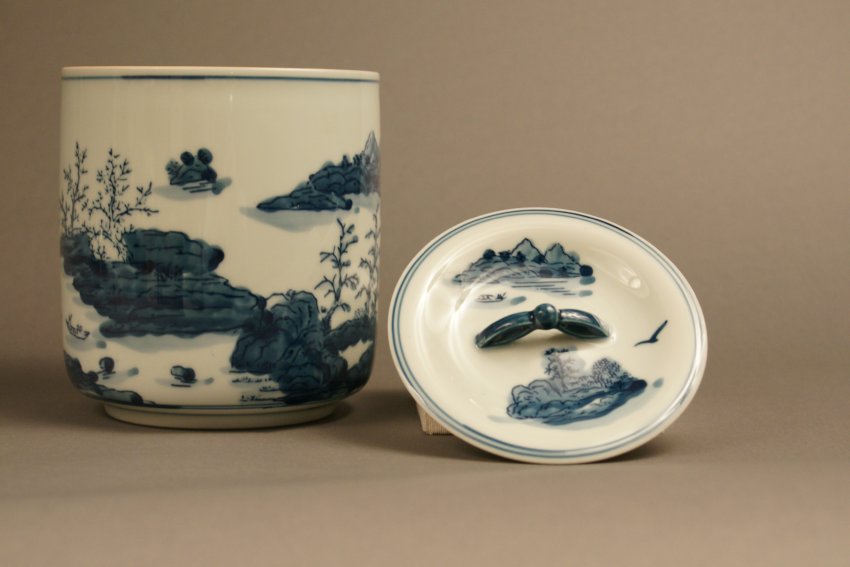
The phrase ‘blue and white’ is synonymous with porcelain that originated in China during the 7th and 8th centuries. The distinctive deep blue color comes from adding the mineral cobalt. The stark contrast of white base with intricate blue designs quickly became popular and spread throughout Asia.
Cobalt is a mineral and an expensive material yet it very consistently holds its color in the kiln, making it a favorite medium among Japanese potters. There are two kinds of cobalt. Cobalt oxide is preferred for its intensity and because it requires less material to create bold color. The other is cobalt carbonate, which is favored for its finer grain, and therefore produces a more even spread. Cobalt is also used industrially because of its strength, magnetic properties and by acting as a catalyst for chemical reactions.
The technique used for the ceramic works is called ‘underglaze cobalt blue.’ The detailed compositions are painted on the body of the plain vessel, sometimes utilizing a stamp or stencil. After being bisque fired in a kiln, a clear coat of glaze is applied on top and the piece is fired a second time. This creates a smooth, lustrous and durable surface.
Most people are familiar with indigo because it is the color that originally made blue jeans blue. It’s a botanic dye that has been used throughout the world by many different countries and cultures. Some of the oldest examples – more than 6,000 years old – were found in Peru. China, Korea and Japan have also produced material with this dye on an industrial scale.
Indigo is derived from the leaves of plants in the genus Indigofera of the pea family. In addition to being a good colorant, these shrubs have many medicinal properties. They grow throughout tropical and subtropical regions. The leaves are soaked in water and fermented for several days. A base, such as calcium hydroxide, is added to make the solution less acidic. This solution, which is yellow at first, turns to deep blue when exposed to air.
The most common technique that is used for creating designs on fabric is called ‘paste resist dying.’ The paste, which is usually made from rice flour, prevents the fabric from absorbing the dye where the paste is applied. Designs can be hand drawn or applied with stencils to produce complex and detailed patterns.