Clifton Karhu: An American in Kyoto
Open to the public Friday, September 18, 2026 – Sunday, January 17, 2027
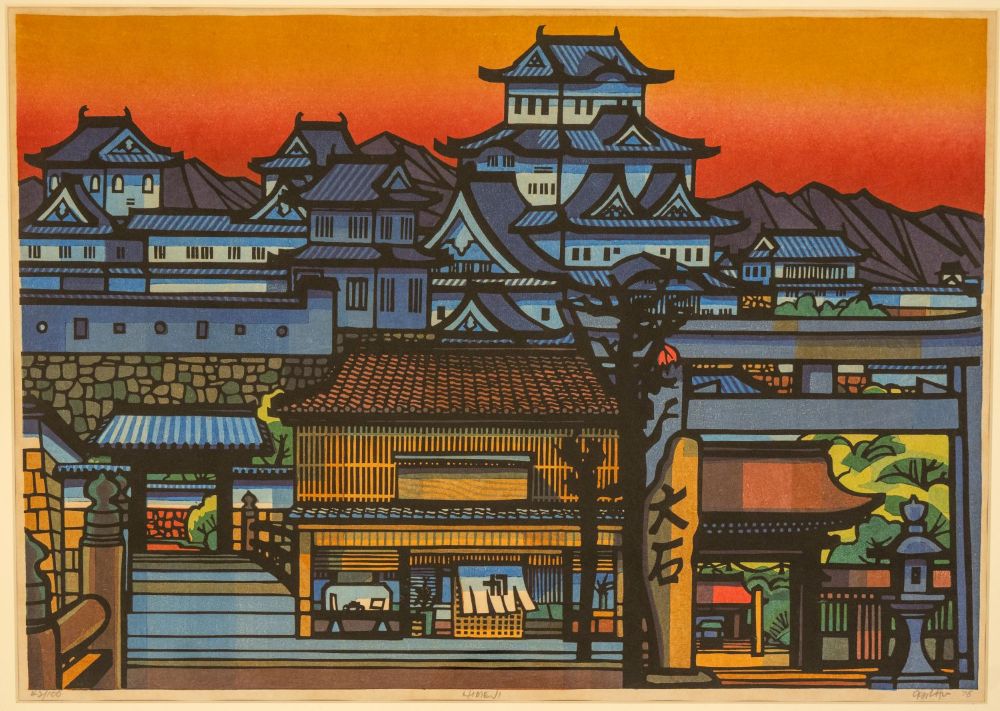
This exhibition highlights the role of an American living and working in Japan, who enriched American art by introducing innovative techniques and perspectives from Japanese culture. Clifton Karhu (1927-2007) was born in Duluth, Minnesota. He served in the U.S. military and spent two years at the naval base in Sasebo, Kyūshu. He returned to Japan years later as a missionary, but quickly became disillusioned and resumed his study of art. He was the first non-Japanese artist admitted to the Japan Print Association. His work specifically illuminates the creative (sosaku) print movement of modern Japan. He was well regarded as a Japanese flute (shakuhachi) player and made it a habit to wear a kimono daily. This exhibition features woodblock prints, ceramic and stone works produced by the artist, all of which are works from the Museum Collection.

Himeji “White Heron” Castle in Himeji
by Clifton Karhu (American, b. 1927)
Woodblock print; ink and colors on paper
Shōwa period, dated 1978
Gift of Mr. and Mrs. Mike Marcus
1995.018.030
Watanabe Geisha Residence in Kyoto
by Clifton Karhu (American, b. 1927)
Woodblock print; ink and colors on paper
Shōwa period, dated 1980
15 in. H x 19 in. W
Gift of Mr. and Mrs. Mike Marcus
1995.018.006
Dancing Brush: The Art of Calligraphy
Open to the public Friday, September 26 – Sunday, November 29, 2026

Absorption of Chinese characters into Japan along with Buddhist texts in the 6th century formed the basis of the Japanese writing system. Some characters are borrowed for their meaning; others are borrowed for their sound. This merged with the Japanese spoken language in the 9th century to form hiragana – primarily used to write native Japanese words and grammatical elements – and katakana, used to transliterate foreign words.
Shodō is directly translated as ‘the way of writing’. It is a calligraphic art form. This is different from shūji, which is merely penmanship. Shodō is abstract expressionism: the authenticity or value of a work lies in its directness and immediacy of emotional expression. These artistic creations can be difficult to read – even for native Japanese speakers.
The materials used are simple. Generally, paper, or sometimes silk, is used along with sumi ink. Sumi is fine soot held together with an animal-based glue. It is ground on an ink stone with a bit of water to turn the hard stick into a liquid ink. The brushes are usually comprised of a bamboo handle and animal hair fibers. These are the exact same tools used by ink painters, further emphasizing the artistic nature of fine calligraphy.
In this exhibition, you will find various styles of calligraphy by artists from the 19th and 20th centuries. There are seven hanging scrolls and two fans with only calligraphy, three scrolls that combine painting and calligraphy, and some of the tools needed to produce these works. All objects are from the Morikami Museum Collection.
Dancing Skeleton
Signed Haku’un
1891, Meiji period
Ink on paper
Gift of Laura Hammond and Dr. Larry P. Levin, in loving memory of their fathers Neal Hammond and Artie Levin
2006.040.002a-b